
Introduction: why preload decides how an axis behaves
Preload is the one line on a linear guide drawing that quietly decides whether an axis feels tight and precise or smooth and short-lived, and it is usually the line nobody argues about until the machine is already built. A carriage with no preload has clearance inside it; the axis can move a few microns before anything resists. A carriage with too much preload has no clearance at all; every ball is under load at rest, the grease film thins, and the rail runs warm from the first hour. Both machines will cut parts. Only one of them will still hold tolerance a year later.
This guide is about choosing that line. It explains what preload physically does inside a carriage, why it is not the same thing as accuracy grade, how the four practical bands behave against load, stiffness, friction and life, and how to pick a band from the job the axis actually has to do. The numbers that matter for ordering — accuracy grade C, H, P, SP or UP, rail width from 5 mm to 65 mm, series MGN, MGW, HGR, VR or SBR, bearing steel or S55C — are all on the product pages. What is not on any product page is the reasoning that connects a machine to a preload, and that is what follows.
Core concept: what preload actually does inside a carriage
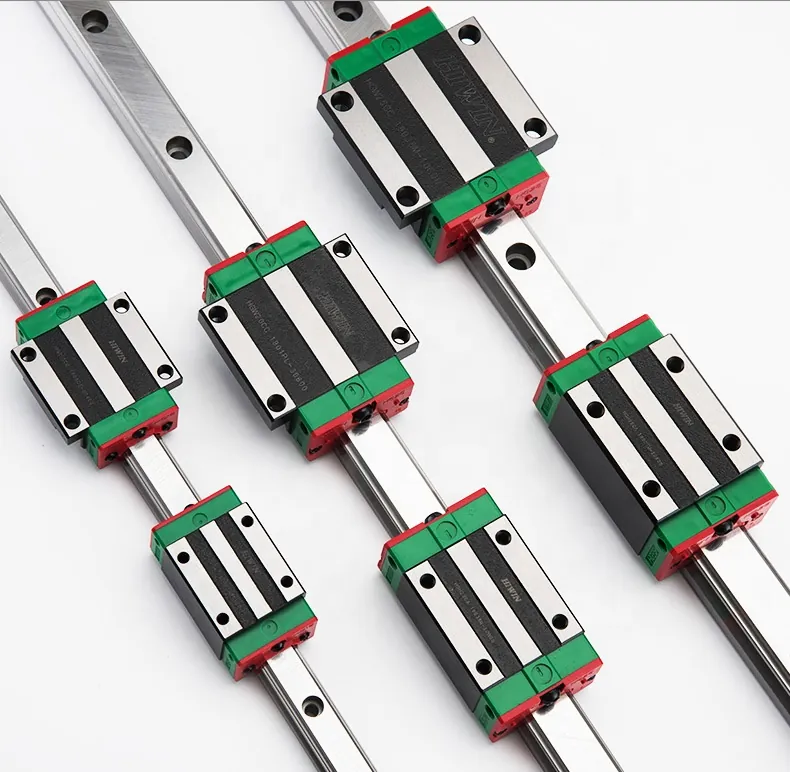
A recirculating linear guide carries load through balls running between the rail raceway and the carriage raceway. The raceways are ground slightly larger than the ball diameter, which is what allows the carriage to slide at all: there is a small internal clearance, typically a few microns, between ball and groove on the unloaded side. Under load the carriage deflects until the balls on the loaded side compress and the clearance on that side closes.
Preload means building the carriage so that this closing has already happened before any external load arrives. Oversized balls, or raceways ground to a slightly tighter spacing, put the balls in elastic compression at assembly. The carriage now sits in a state of internal stress: the upper and lower rows push against each other, and the whole block is rigid in every direction instead of only under load.
Three consequences follow, and every selection decision is a trade between them.
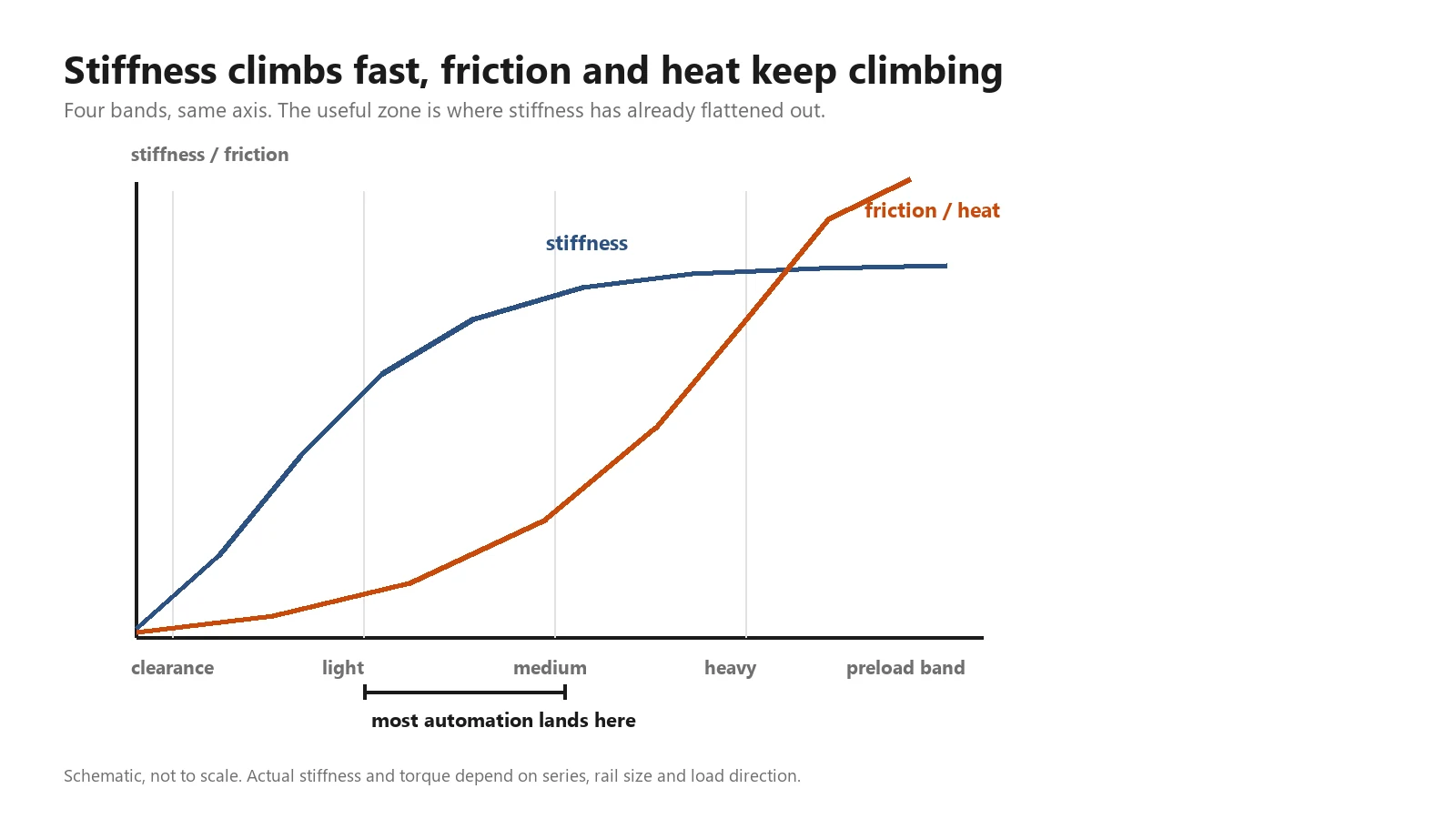
- Stiffness rises. The load-deflection curve of a ball contact is progressive, not linear: the more it is already compressed, the flatter the curve around the working point. A preloaded carriage deflects far less per unit of load than a clearance-fit one, and it does so in both directions, which matters on an axis that reverses.
- Friction rises. More compression means more contact stress on every ball and a thinner lubricant film. Running torque goes up, heat goes up, and the drive has to supply more force just to move.
- Life falls if the preload is excessive. Bearing life scales with contact stress to roughly the third power for ball bearings. A carriage that is preloaded well beyond what the axis needs pays for that stiffness in fatigue life, not in the catalogue but in the field.
There is also a positioning argument that has nothing to do with stiffness. On a light finishing pass, an axis with clearance can be pushed by cutting force into the clearance band and stay there until the force reverses. The tool follows the force, not the command. Preload removes that band, which is why preloaded carriages appear on finishing axes and clearance-fit carriages appear on axes where the load is always in one direction and the drive is heavily geared.
Classification: the four practical preload bands
Catalogues label preload with codes, and the codes differ between manufacturers. What does not differ is the physical situation being described, and it is worth thinking in bands rather than in letters.
Band 1 — clearance fit (no preload)
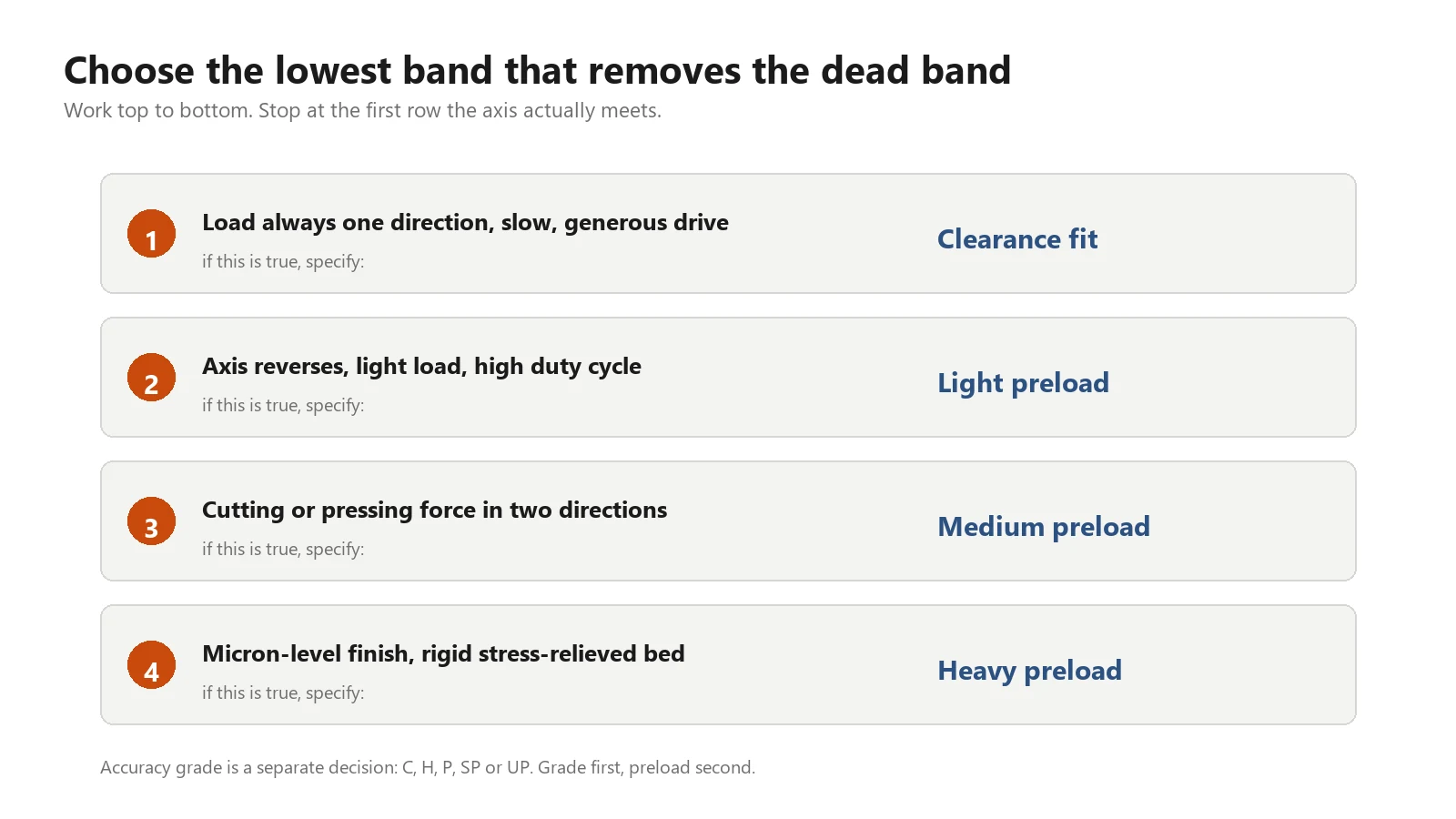
The carriage retains a small internal clearance. It runs with the lowest friction and the lowest heat, accepts the widest mounting error without binding, and is the cheapest to assemble because nothing has to be matched. Its weakness is the dead band: at low load the carriage floats, stiffness is near zero until the clearance closes, and the axis can oscillate or leave marks when a light load reverses direction. Clearance fit suits slow, heavily loaded, single-direction axes and applications where a slight rock is acceptable.
Band 2 — light preload
Enough compression to remove the dead band and give predictable stiffness in both directions, without a large friction penalty. This is the default for general automation: pick-and-place, light CNC, dispensing, labelling, camera slides. It tolerates normal machining tolerance in the bed, runs cool, and keeps a sane life margin. When a customer is unsure and the axis is not a precision measuring axis, light preload is usually the right starting point.
Band 3 — medium preload
A deliberate step up in stiffness, used where the axis has to hold position against a real cutting or pressing force and where reversal accuracy matters: router Z axes, small machining centres, press-fit stations, test rigs that apply load in two directions. Friction and heat are noticeably higher, lubrication becomes a maintenance item rather than an afterthought, and the mounting faces have to be flat and parallel because a medium-preloaded carriage will not absorb bed error — it will transmit it into the rail and bind.
Band 4 — heavy preload
Maximum stiffness, minimum deflection, highest friction. Found on precision finishing machines, EDM and grinding axes, wafer and optical stages, and any axis where a micron of elastic give shows up in the part. Heavy preload demands a rigid, stress-relieved, accurately machined structure, a defined lubrication schedule, and a realistic life calculation. Putting heavy preload into a welded frame that was never machined is one of the most reliable ways to destroy a set of carriages in a few months.
Preload is not accuracy grade
This is the single most common confusion, and it is worth stating plainly. Accuracy grade — the C, H, P, SP and UP classes used on the rails and carriages supplied for these axes — describes dimensional tolerance: how straight the rail is, how parallel the running surfaces are, how much the carriage height and width vary from unit to unit. Preload describes internal compression: how hard the balls are squeezed inside a given carriage.
You can buy a P-grade rail with light preload, and you can buy an H-grade rail with medium preload. The first will be geometrically accurate but not especially stiff. The second will be stiff but its straightness tolerance is looser. Machine builders who order a high grade expecting stiffness, or a high preload expecting accuracy, end up with an axis that is neither.
Pros and cons: what each band buys and costs
The table below is the trade in one view. It is deliberately qualitative: the right band for a given machine depends on load, stroke, speed, duty cycle and structure stiffness, and no catalogue row can decide that for you.
| Band | Stiffness | Friction and heat | Life at rated load | Tolerance to bed error | Where it earns its place |
|---|---|---|---|---|---|
| Clearance fit | Low until load closes the gap | Lowest | Highest | Forgiving | Slow single-direction axes, lifting, clamping, manual slides |
| Light preload | Moderate, equal both directions | Low | High | Forgiving | General automation, light CNC, pick-and-place, camera axes |
| Medium preload | High | Moderate | Moderate | Needs a machined bed | Router Z, small machining centres, press stations, two-direction loading |
| Heavy preload | Very high | High | Lowest | Needs a rigid, accurate bed | Precision finishing, grinding, EDM, metrology stages |
Two costs are easy to underestimate. The first is drive sizing: raising preload raises running friction, and on a small stepper-driven axis that extra drag can eat the margin that was supposed to cover acceleration. The second is thermal: a medium or heavy preloaded carriage running dry or under-lubricated will warm the rail, the rail grows, and on a long axis the growth shows up as a change in preload from one end to the other.
Parameters and technical standards that decide the choice
Preload is never selected in isolation. It sits inside a set of tolerances, and four of them interact with it directly.
Accuracy grade sets the floor
Rails and carriages are supplied in grades C, H, P, SP and UP. Grade determines running parallelism and the allowed variation in carriage height and width. A high preload on a low grade cannot produce a precise axis: the carriage is stiff, but it is stiff around a rail that wanders. If the requirement is real positioning accuracy, the grade has to come up first and the preload second.
Rail size and series set the load path
Miniature series — MGN from 5 mm to 15 mm, MGW from 12 mm — carry light loads on small balls and small raceways. At these sizes the preload band is narrow in absolute terms, and a medium preload on an MGN7 is a much larger relative change than the same band on an HGR35. Heavy series such as HGR15, HGR20 through HGR65 have larger balls and deeper grooves, so they tolerate higher preload with less relative friction penalty. VR and SBR types behave differently again because of their roller or shaft-mounted geometry.
Material and surface treatment
The rails and carriages in this range are made from bearing steel and S55C, hardened and ground on the raceways. Hardness and case depth determine how much contact stress the groove can take before indentations appear, and preload is exactly a controlled contact stress. A preloaded carriage running on a soft or poorly ground raceway will brinell — small permanent dents where the balls sit — and once that happens the axis is noisy and the preload is gone.
Sealing and lubrication
End seals and side seals keep chips and coolant out and grease in. Higher preload means more contact stress and more heat, which means the lubricant has to be present and appropriate. On a medium or heavy preloaded axis, a dry start after a weekend is a real wear event: the first few strokes run metal on metal until the film re-forms. Preloaded axes therefore usually get a defined re-lubrication interval rather than "grease it when it squeaks".
Application scenarios: matching the band to the machine
The same four bands look different depending on what the axis does all day. These are the cases that come up most often when a machine builder asks which preload to specify.
General automation and pick-and-place
Loads are light, strokes are short, duty cycles are high, and the axis reverses constantly. The dead band of a clearance fit shows up as a small hesitation at each reversal, which becomes a visible placement error at the gripper. Light preload removes the hesitation at almost no cost in heat or life, which is why it is the default here. If the axis is vertical and holds a load at rest, the same light preload also keeps the brake from having to fight a floating carriage.
CNC routers and woodworking gantries
Cutting force is real but intermittent, and the machine is usually a welded or bolted frame that has been machined only on the rail faces. Where the axis is bought as a ready-made linear module rather than built from rail and carriage, the preload has already been decided by the module supplier and only has to be verified against the load case. Light to medium preload is the practical range. Medium gives the stiffness a Z axis needs when plunging, but only if the gantry beam is stiff enough that the carriage is not the softest element in the chain — preloading a carriage inside a flexing beam just moves the deflection somewhere else. On a long X axis, thermal growth matters more than the band itself.
Precision finishing, grinding and EDM
Here the requirement is not load capacity but repeatability under a light, reversing force. Medium to heavy preload is normal, together with a high accuracy grade and a bed that has been stress-relieved before final machining. The limiting factor is usually lubrication discipline and thermal stability rather than the guide itself.
Measuring, vision and dispensing axes
Very light loads, but the axis must not creep or hesitate. A preloaded carriage gives a predictable, linear response to small commands, which is what a vision axis needs when it makes a 20-micron correction. Heavy preload is rarely necessary — the loads are tiny — and the friction penalty shows up as heat near the camera and as drive tuning difficulty. Light preload with a high grade is usually the better answer.
Vertical and lifting axes
Load direction is constant, so the dead band matters less than holding ability. Clearance fit is acceptable on slow lifts, but any axis that stops and starts under load benefits from light preload because it prevents the carriage from settling into the clearance band each time the brake releases.
Common problems and what they actually indicate
Most preload problems are diagnosed backwards: the symptom is blamed on the guide when the cause is the structure, the lubrication or the assembly. The table maps what is observed to what is usually wrong.
| Symptom | Likely cause | What to check first |
|---|---|---|
| Rail warm within minutes, even unloaded | Preload too high for the duty cycle, or grease starved | Running torque against a comparable spare; lubricant quantity and grade |
| Binding in the middle of the stroke only | Bed not straight; the carriage is absorbing bed error | Straightness of the mounting face along the rail line |
| Loose feel at stroke ends, tight in the centre | Rail bowed, or two rails not parallel | Parallelism between datum and follower rail at five stations |
| Noise that grows over weeks | Brinelling from overload or from a dry start | Raceway surface under magnification; lubrication history |
| Position error that changes with direction | Clearance band still present — preload lost or never specified | Whether the carriage was supplied preloaded, and whether balls or cage were replaced |
| Uneven wear on one raceway only | Moment load beyond rating, or mounting shoulder not in contact | Load calculation including offset; contact of the reference shoulder |
| Drive overheating on a small stepper | Friction from a preload band higher than needed | Actual running force versus the force used to size the motor |
One failure deserves separate mention because it is invisible until it is expensive: preload is lost when a carriage is disassembled. Removing a carriage from its rail without a dummy rail lets the balls escape, and re-inserting them by hand cannot reproduce the matched ball set. A carriage that has been opened is a different carriage, and it should be treated as one.
Selection and installation tips
A workable sequence, in the order that avoids rework:
- Start from the load, not the catalogue. Work out the actual force on the carriage including the moment from an offset load. Preload is chosen to keep the carriage inside its elastic range under that force, not to be as high as possible.
- Decide the accuracy grade first. If the machine has a positioning requirement, the grade follows from it. Preload then follows from the stiffness requirement. Getting these the wrong way round produces an axis that is expensive and still inaccurate.
- Choose the lowest band that removes the dead band. For most automation that is light preload. Move up only when a measured deflection, a reversing force or a surface finish problem demands it.
- Check what the structure can support. A preloaded carriage transmits error instead of absorbing it. If the mounting face is not machined and straight, a higher preload will convert a small inaccuracy into binding and heat.
- Size the drive with the preload in it. Running friction from preload is part of the force budget. Whether the axis runs on a belt, a rack or a ball screw, a motor sized on load alone will be short on acceleration once the carriages are preloaded.
- Plan the lubrication before commissioning. Preloaded axes need a defined grease quantity and interval. Running in should be gentle: a short, slow, unloaded cycle lets the film distribute before the axis sees cutting force.
- Record what was fitted. Preload and grade belong on the machine record. When a carriage is replaced two years later, the replacement has to match, and "same as before" is not a specification.
During assembly, mount and torque the datum rail first, then bring the follower rail to it with the carriage or a bridge already in place, and measure parallelism at both ends, the quarter points and the centre. If the axis binds in the middle after torqueing, the bed is telling you it is not straight — shim it rather than reducing preload to hide the problem.
FAQ
Is higher preload always more accurate?
No. Preload raises stiffness, which reduces deflection under load. Accuracy comes from the rail's grade, the straightness of the mounting face and the stiffness of the structure around it. A heavy preload on a soft frame produces an axis that is stiff locally and inaccurate overall, and it runs hot.
Can I convert a standard carriage to preloaded later?
Not by adjustment. Preload is built in at assembly through ball size or raceway spacing. The practical route is to order the carriage in the required band. Opening a carriage to change balls destroys the matched set and usually the preload with it.
How do I know if the preload is too high on a running machine?
Temperature and running force are the two accessible indicators. Compare the running torque or push force against a comparable axis, and check rail temperature after a representative cycle. A rail that is noticeably warm with no external load, or a drive drawing more current than the calculation predicted, is a sign the band is above what the duty cycle supports.
Does preload change with rail size?
The band name does not, but the absolute effect does. The same nominal band on a 5 mm miniature carriage is a larger relative change in contact stress than on a 35 mm heavy-series carriage, because the balls and raceways are much smaller. Miniature axes therefore need more care in the choice, and heavy series tolerate more.
What happens to preload over the life of the machine?
It decays. Wear polishes the raceways, and repeated overload or a dry start can brinell them. Gradual loss of stiffness, a new dead band at reversal, or a change in surface finish are the symptoms. There is no field adjustment; the carriage is replaced.
Should a vertical axis use a different preload from a horizontal one?
The load path is different but the selection logic is the same. A vertical axis usually benefits from at least light preload so the carriage does not settle into clearance each time the brake releases, and so a held load does not produce a small drop on release.
Conclusion
Preload is a stiffness decision with a friction and life price attached, and it is separate from the accuracy grade that governs how straight and how consistent the rail is. Clearance fit is for slow single-direction axes; light preload is the sensible default for general automation; medium and heavy belong to machines whose structure and lubrication can support them. The selection order matters more than the band itself: load first, grade second, preload third, structure and drive checked against both.
Most of the failures that get blamed on preload are really mounting, lubrication or a carriage that lost its matched ball set during maintenance. Getting those right is what makes a chosen preload behave the way the drawing says it should.
Ordering a preloaded guide
Rails and carriages in this range are supplied in accuracy grades C, H, P, SP and UP, in rail widths from 5 mm to 65 mm across the MGN, MGW, HGR, VR and SBR series, in bearing steel and S55C, with lead times of 5 to 15 days. Preload band is confirmed against the drawing rather than guessed from a code, because the same letter means different things in different catalogues.
Custom size is available, OEM and ODM builds are supported, and bulk wholesale quantities are quoted on the same specification basis. Send the axis drawing — load, stroke, speed, mounting arrangement and the accuracy grade you need — and the technical team will come back with the preload band, the series and a quotation. Technical drawings and dimensional confirmation are available before order.