
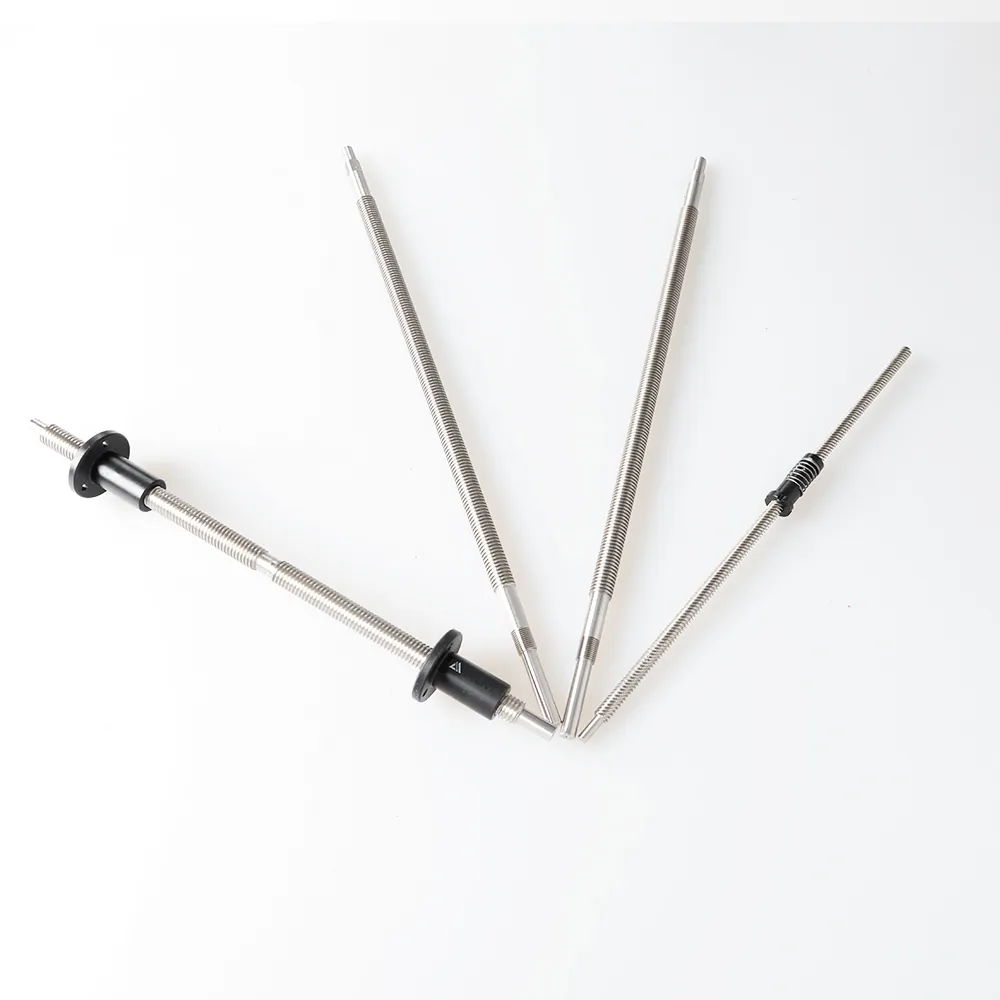
ASTM1045,SUS303,SUS304 — T8–T16 Lead Screw, lead, for CNC and 3D printers
Request pricing, MOQ and lead time for this product — we reply within 24 hours.
Dimensions and configuration
| Diameter | 8 mm |
|---|
Material and surface treatment
| Screw material | ASTM1045,SUS303,SUS304,SS316,SS316L |
|---|---|
| Surface coating | Zinc-plated,nickel plated,hard chromium plated,fluorine coated,tungsten disulfide,black chorme plated |
| Surface treatment | Custom lead nut and shaft end machining |
Accuracy and running characteristics
| Clearance | 7e,higher precision is available upon request |
|---|
Supply conditions
| Customisation | Customized nuts and end machining are available upon drawing |
|---|---|
| Warranty | 1.5 year |
| Place of origin | Jiangsu, China |
Values above are the manufacturer's published figures for this series. Anything not listed — dynamic load rating, straightness, preload class — is confirmed against the drawing at RFQ.
Available models (7)
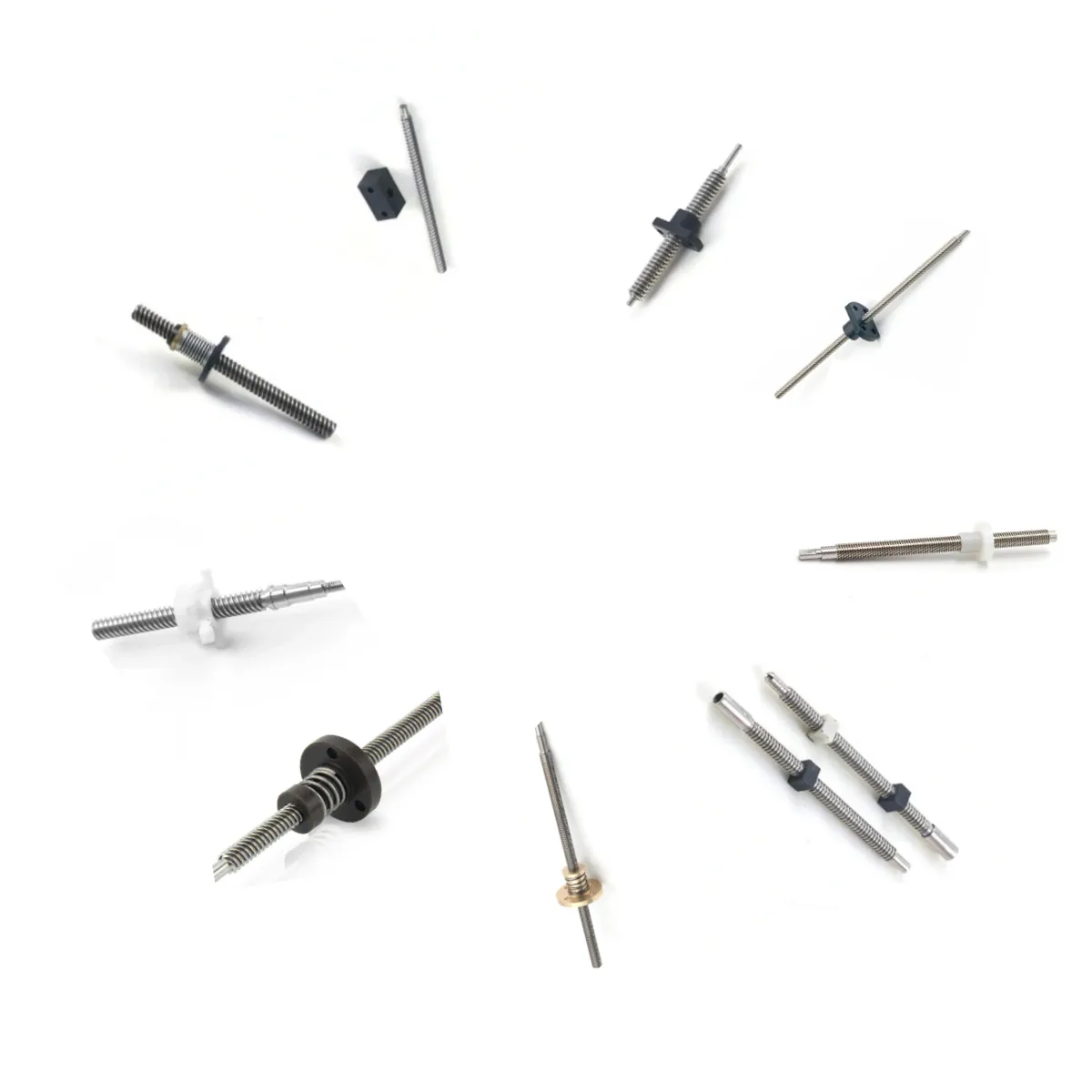
This part is supplied in the following model and size combinations. State the model on your RFQ and we quote that variant.
| Model | Configuration |
|---|---|
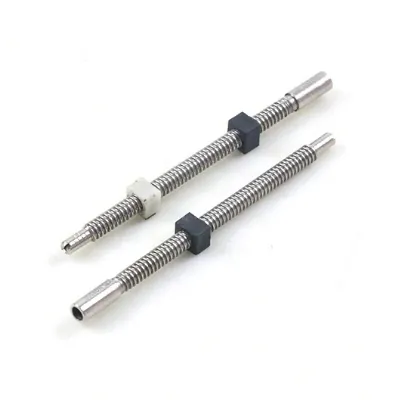
| 1601427242636 | Stainless T8 Lead Screw |
| 1601389685910 | 2025 Product T8 Lead Screw Machine Accessories |
| ASTM1045, SUS303, SUS304 | Precision T8–T20 Lead Screw ASTM1045,SUS303,SUS304 |
| 1601424891602 | Stainless T8 Lead Screw |
| 1601316542605 | Lead Screw Nut Sleeve Set Recipe Nut Holder T8 |
| T16 | T8 8mm16mm T16 Lead Screw 3D Printing Lead Screw |
Description
Overview
The working principle of a lead screw is a screw thread used as an inclined plane: the nut converts torque into thrust, and the mechanical advantage comes from the lead being much smaller than the circumference of the shaft. That is why a lead screw can hold a vertical load without a brake and why it is chosen on machines where a simple, self-locking axis is wanted. The trade is friction and efficiency, and the nut material is what decides how much of each.
Key Features
· Warranty: 1.5 year
· Weight (kg): 0.8
· Video outgoing-inspection: Provided
· Machinery test report: Provided
· Core components: Motor
· Manufacturing process: Rolled Thread
· Supplied as a replacement part or as a production item for machine builders
· Material, tolerance and surface treatment confirmed against the drawing
Specifications
The parameter table above lists the values published for this item. Where a value depends on the machine it is going into, the drawing or the RFQ fixes it, and we confirm before production rather than after.
Application
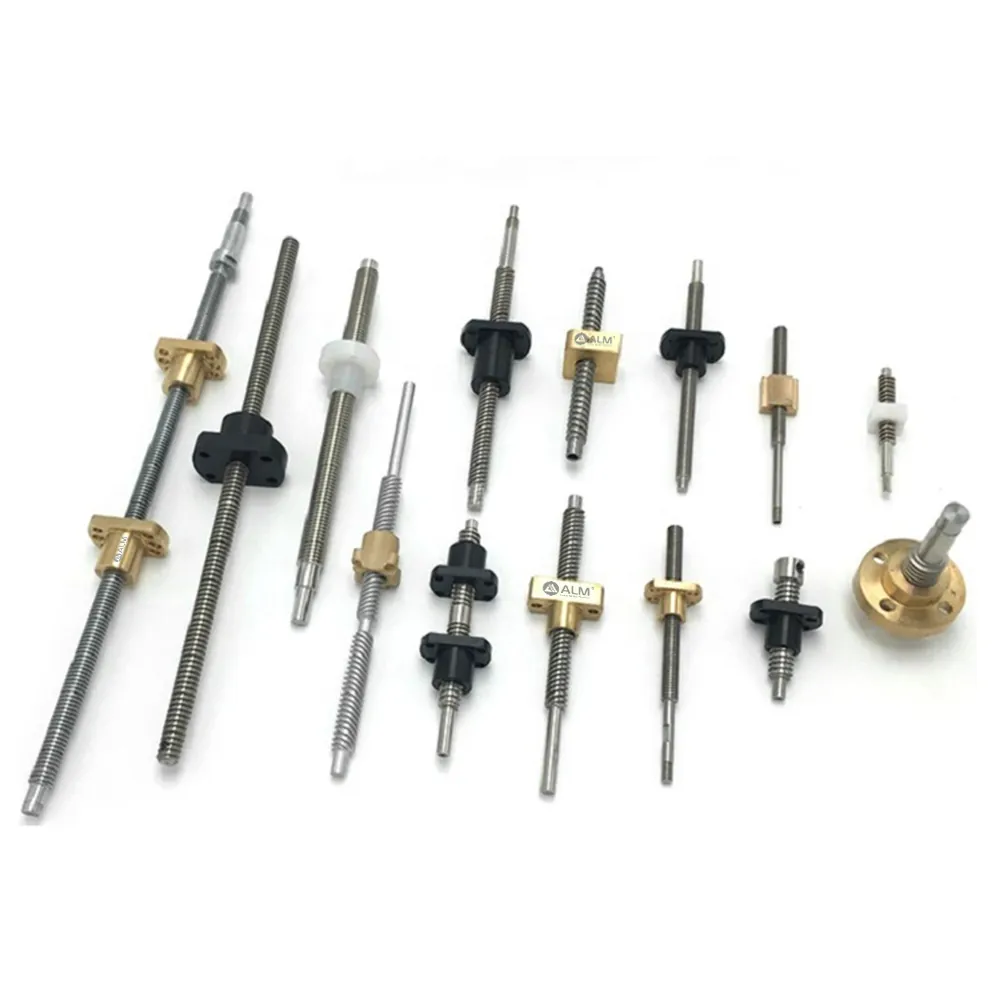
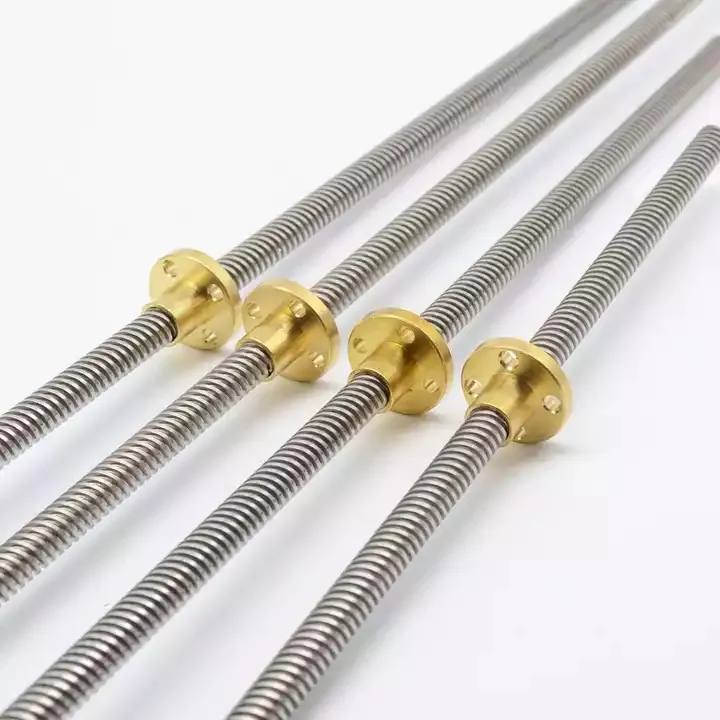
Model designation: ASTM1045, SUS303, SUS304. Shaft material: ASTM1045, SUS303, SUS304, SS316, SS316L. Nut material: POM, Brass, Bronze, PEEK, nylon.
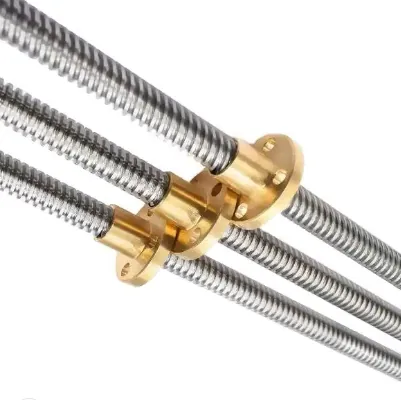
Material choice is driven by the environment and by the nut pair. A carbon steel shaft with a bronze nut is the classic combination for dry or lightly lubricated industrial axes; a stainless shaft with a polymer nut suits clean rooms, food equipment and instruments, and reduces the risk of galvanic corrosion at the nut. The listing covers 1045 and the 300 series stainless grades, and the nut materials listed are POM, brass, bronze, PEEK and nylon, so the pair can be matched to the load, the temperature and the lubrication available.
Backlash between the nut and the thread is the quantity that decides how the axis behaves on a reversal. A small clearance keeps the drive free but shows as lost motion when the direction changes; an anti-backlash nut removes that clearance with a spring or a split nut, at the cost of more friction and faster wear. On a vertical axis a small amount of clearance is acceptable because gravity keeps the nut loaded on the same flank, while on a horizontal axis that reverses under load the clearance appears directly as position error.
Grade and clearance work together and should be specified together. The thread class sets how much material is on the flanks, and the nut fit sets how much of that becomes clearance. On a machine that has a closed loop with a linear encoder, the screw only has to transmit force and the class can be relaxed; on an open loop machine the class and the clearance both appear in the finished part, so they are worth paying for.
Manufacturing process: Rolled Thread. Clearance: 7e, higher precision is available upon request. Surface treatment: Black chrome plated and so on.
Installation & Maintenance
Life is governed by the nut, not the shaft. A bronze nut in a lubricated industrial axis runs for a long time; a polymer nut in a dry, dusty machine wears faster and produces a fine powder that then acts as an abrasive. Where the nut is the wear part, design access to it: a nut that can be replaced without dismantling the machine turns a long job into a short one, and that is often worth more than a small gain in nominal life.
End machining is what decides whether a screw runs true. The journal at the driven end is turned to suit the bearing and is normally shouldered so the inner ring is clamped axially; the far end is either supported in a floating bearing that allows thermal growth or left free for short screws. Angular contact or deep groove bearings are used at the fixed end, and the preload of that bearing pair sets the axial stiffness of the whole axis. A screw clamped between two fixed bearings without allowance for thermal growth will bow when it warms up.
Cleaning and re-greasing at a fixed interval is the whole maintenance story on most machines. Wipe the thread with a lint-free cloth, remove the old grease with a solvent that does not attack the nut material, and re-apply the specified grease thinly and evenly. Do not mix grease types, because some thickeners are incompatible and the mixture can harden. On a machine that runs intermittently, run the axis through its full travel after greasing so the film is distributed over the whole working length.
Typical applications are the axes of machines that move slowly and hold position: 3D printers and laser engravers, desktop CNC routers, laboratory and medical positioning stages, camera and sensor sliders, valve actuators, packaging and labelling machines, and the adjusting axes on woodworking and metalworking equipment. In each case the lead screw is chosen because it holds without a brake, runs quietly, and costs less than a ball screw of the same size.
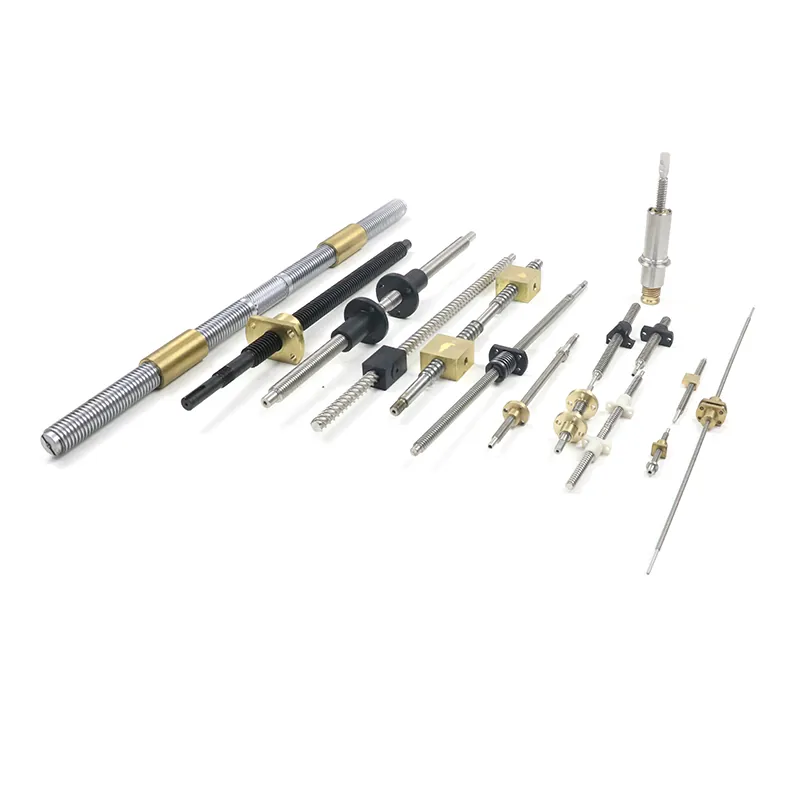
Ordering detail that prevents a wrong part: the hand of the thread, because a left hand screw is not obvious from a photograph; the position of the thread on the shaft, since a screw threaded over its whole length is not the same part as one threaded between two journals; and whether the nut is flanged or cylindrical. A sketch with the dimensions marked is worth more than a paragraph of description, and it removes the ambiguity that causes most returns.
Package & Lead Time
Standard export packing: each part is sleeved and cartoned, screws and rails are protected along their length, and larger assemblies travel crated. Lead time is confirmed with the quotation: standard sizes normally ship within 5 to 15 days of a confirmed drawing, custom parts against the agreed schedule. Minimum order is one piece, and sample orders are accepted before a production run.
Request a Quote
Send the model number or the drawing, with the shaft or rail size and the quantity you need, and we will reply with a quotation. For non-standard lengths, bore pairs, keyways and material changes we work from your drawing; bulk orders are quoted per quantity band and a sample can be supplied for approval.
Related components
Detail images
Related products
Interested in this product?
Send your details and we will respond within 24 hours.