
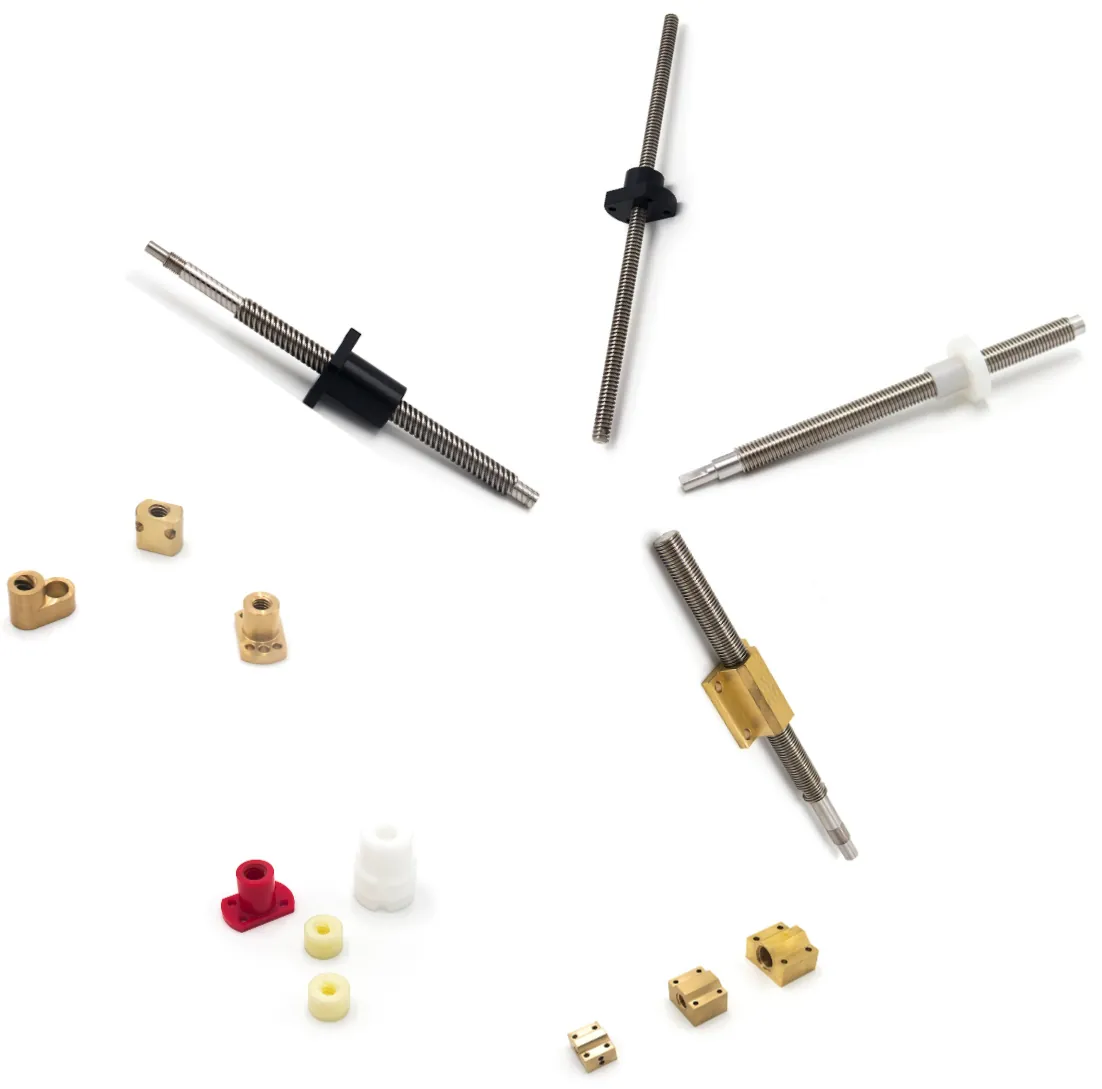
POM Brass Bronze Nylon Acme Nut 1/4 Diameter, for CNC and 3D printers
Request pricing, MOQ and lead time for this product — we reply within 24 hours.
Material and surface treatment
| Surface coating | Zinc-plated,nickel plated,hard chromium plated,fluorine coated,tungsten disulfide,black chorme plated |
|---|---|
| Surface treatment | Custom lead nut and shaft end machining Various |
Accuracy and running characteristics
| Clearance | 7e,higher precision is available upon request |
|---|
Supply conditions
| Customisation | Customized nuts and end machining are available upon drawing |
|---|---|
| Warranty | 1.5 year |
| Place of origin | Jiangsu, China |
Values above are the manufacturer's published figures for this series. Anything not listed — dynamic load rating, straightness, preload class — is confirmed against the drawing at RFQ.
Description
Overview
A lead screw turns rotation into straight-line movement through a threaded shaft and a nut that travels along it. The thread form, the diameter and the lead set the character of the drive: a fine lead gives more force for a given motor torque and finer positioning steps, while a coarse lead gives speed. The screw in this listing is supplied as a shaft with the thread rolled or cut over the working length, with the ends machined to suit the bearing supports and the drive coupling of the machine it goes into.
Key Features
· Warranty: 1.5 year
· Weight (kg): 0.8
· Video outgoing-inspection: Provided
· Machinery test report: Provided
· Core components: Motor
· Manufacturing process: Rolled Thread
· Supplied as a replacement part or as a production item for machine builders
· Material, tolerance and surface treatment confirmed against the drawing
Specifications
The parameter table above lists the values published for this item. Where a value depends on the machine it is going into, the drawing or the RFQ fixes it, and we confirm before production rather than after.
Application
Shaft material: ASTM1045, SUS303, SUS304, SS316, SS316L. Nut material: POM, Brass, Bronze, PEEK, nylon. Manufacturing process: Rolled Thread.
The shaft materials listed for this range are ASTM 1045 carbon steel and the stainless grades 303, 304, 316 and 316L. Carbon steel is the usual choice for general machinery because it is stiff and takes a rolled thread well; the stainless grades are specified where the screw will see moisture, wash down or a corrosive atmosphere, and 316L is the grade for the harshest of those. Surface treatment such as black chrome plating is available where wear resistance or appearance matters, and it also gives some protection against rust on a carbon steel shaft.
Nut choices in this range cover the usual machine building options: a plain polymer nut for light, quiet movement, a bronze nut for load and temperature, and a PEEK nut for aggressive environments. The nut also sets the mounting style, because a flange nut bolts to the moving part while a cylindrical nut sits in a housing. Whichever is used, the nut should be aligned to the screw rather than forced onto it, because a nut that is running at an angle wears on one side and produces a periodic error once per revolution.
Grade and clearance work together and should be specified together. The thread class sets how much material is on the flanks, and the nut fit sets how much of that becomes clearance. On a machine that has a closed loop with a linear encoder, the screw only has to transmit force and the class can be relaxed; on an open loop machine the class and the clearance both appear in the finished part, so they are worth paying for.
Clearance: 7e, higher precision is available upon request. Surface treatment: Black chrome plated and so on.
Installation & Maintenance
Efficiency of a sliding screw is well below that of a ball screw, and that is the price of self-locking and simplicity. The lost energy becomes heat at the nut, so the load and the speed together set the temperature of the nut rather than the load alone. A screw that is run at high load and high speed with a polymer nut will reach its limit on temperature first, and the symptom is a squeal or a softening of the nut face before any visible wear.
End machining is what decides whether a screw runs true. The journal at the driven end is turned to suit the bearing and is normally shouldered so the inner ring is clamped axially; the far end is either supported in a floating bearing that allows thermal growth or left free for short screws. Angular contact or deep groove bearings are used at the fixed end, and the preload of that bearing pair sets the axial stiffness of the whole axis. A screw clamped between two fixed bearings without allowance for thermal growth will bow when it warms up.
Maintenance of a lead screw axis is mostly inspection. Look at the thread for a polished band where the nut spends most of its time, which shows the working zone; check the nut for axial play by rocking the driven part with the motor locked; and listen for a change in pitch as the nut passes a particular point, which points to a damaged section of thread. A nut with measurable play can often be adjusted or replaced on its own, without touching the screw.
Where the axis has to hold a load with the motor off, a lead screw is often the simplest answer: the thread angle of a fine lead makes the drive self-locking, so a vertical axis stays where it is put. That is why lead screws appear on lift and adjustment mechanisms, on the Z axis of small machines, on hospital beds and furniture actuators, and on any mechanism where a person sets a position by hand and expects it to stay.
Ordering detail that prevents a wrong part: the hand of the thread, because a left hand screw is not obvious from a photograph; the position of the thread on the shaft, since a screw threaded over its whole length is not the same part as one threaded between two journals; and whether the nut is flanged or cylindrical. A sketch with the dimensions marked is worth more than a paragraph of description, and it removes the ambiguity that causes most returns.
Package & Lead Time
Standard export packing: each part is sleeved and cartoned, screws and rails are protected along their length, and larger assemblies travel crated. Lead time is confirmed with the quotation: standard sizes normally ship within 5 to 15 days of a confirmed drawing, custom parts against the agreed schedule. Minimum order is one piece, and sample orders are accepted before a production run.
Request a Quote
Send the model number or the drawing, with the shaft or rail size and the quantity you need, and we will reply with a quotation. For non-standard lengths, bore pairs, keyways and material changes we work from your drawing; bulk orders are quoted per quantity band and a sample can be supplied for approval.
Related components
Detail images
Related products
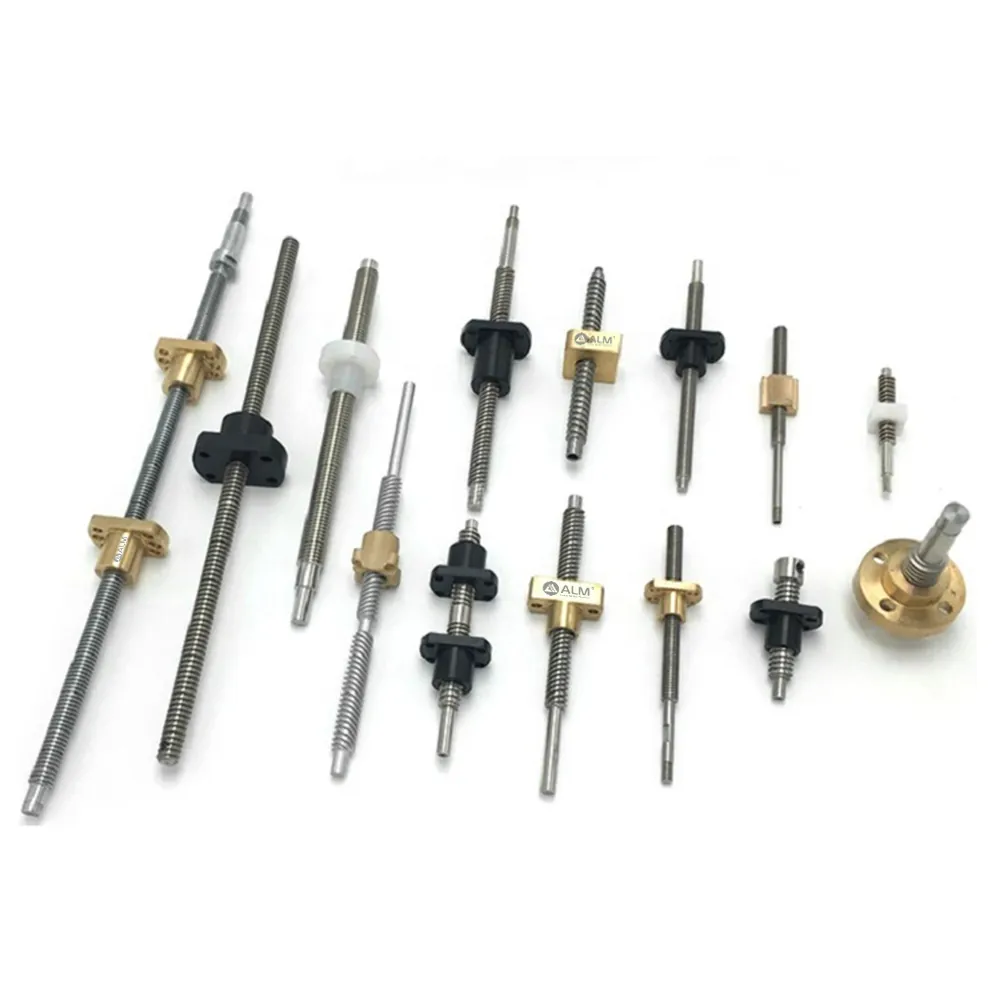
TEBAK Precision Lead Screw, dia 12 mm
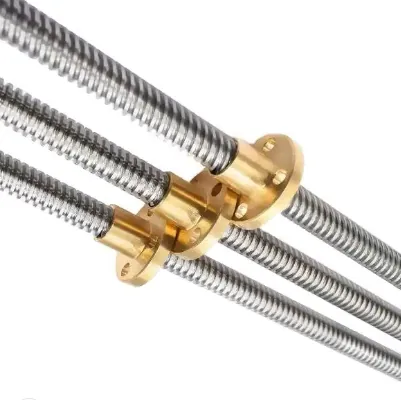
TEBAK T20–T25 Lead Screw, dia 25 mm
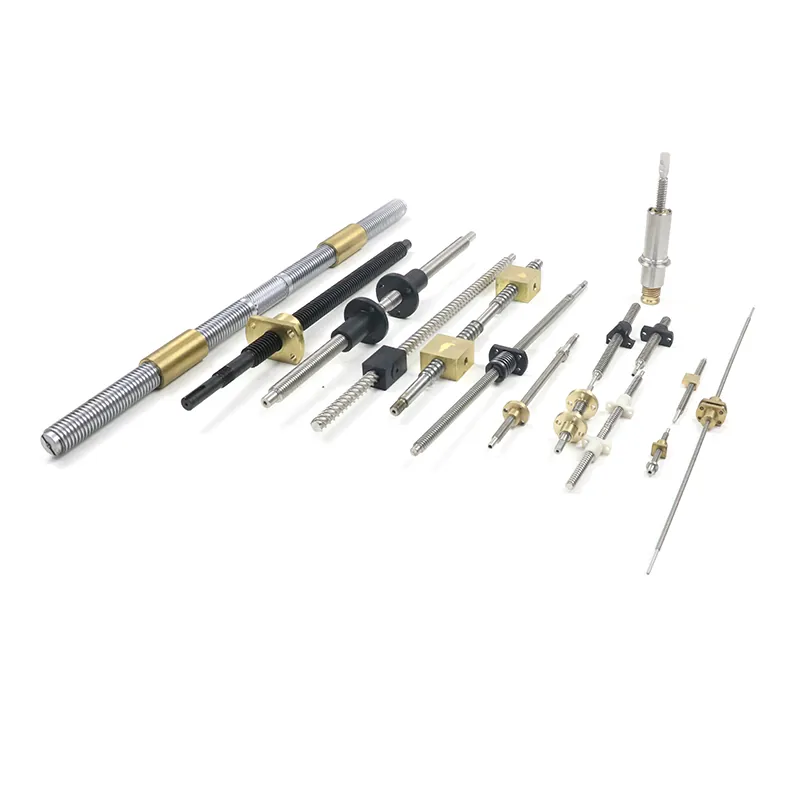
TEBAK Miniature T5–T10 Lead Screw, dia 10 mm
TEBAK Stainless Lead Screw, lead 8 mm
TEBAK ASTM1045,SUS303,SUS304 — T8–T16 Lead Screw, lead
TEBAK Stainless Lead Screw, dia 36 mm
Interested in this product?
Send your details and we will respond within 24 hours.